
The Science Behind Diamond Formation: From Carbon to CaratsThe Science Behind Diamond Formation: From Carbon to Carats
Diamonds have fascinated people for centuries, admired for their brilliance, durability, and value. But the story of a diamond begins long before it reaches a jeweler’s showcase. Every polished gem started as simple carbon atoms deep within the earth, undergoing a remarkable transformation shaped by time, pressure, and heat. The science behind this journey is as captivating as the gems themselves.
Most people know diamonds are rare, but few realize just how extraordinary the process of their creation is. Far beneath the surface, under extreme conditions found only in certain regions of the planet, carbon atoms are pressed together into a crystal structure that gives diamonds their unique hardness and shine. This process takes millions or even billions of years, making every diamond a true geological wonder.
The journey from raw carbon to a sparkling gem does not end with formation. Powerful volcanic eruptions transport rough diamonds to the surface, where they are eventually discovered, mined, and sorted. Each step, from deep earth chemistry to human craftsmanship, contributes to the story behind every carat.
By understanding how diamonds form, we gain a new appreciation for these remarkable stones. The science behind diamond formation reveals not just the beauty and value of each gem, but also the powerful forces that have shaped our planet over unimaginable stretches of time.
What Are Diamonds Made Of?
Although both diamond and graphite are made entirely of carbon, their atomic structures and physical properties are strikingly different, as shown in the table below.
| Property | Diamond | Graphite |
|---|---|---|
| Element | Carbon | Carbon |
| Atomic Structure | Tetrahedral, 3D network | Layered, planar sheets |
| Hardness (Mohs) | 10 (hardest known mineral) | 1-2 (very soft) |
| Appearance | Transparent, brilliant | Opaque, metallic gray |
| Electrical Conductivity | Very low | Very high |
| Main Uses | Jewelry, cutting tools, industry | Pencils, lubricants, batteries |
| Occurrence | Deep mantle, rare | Surface, common |
At their core, diamonds are made entirely of carbon. What sets them apart from other carbon-based materials is the way each atom is arranged in a repeating, three-dimensional pattern known as a crystal lattice. This structure is what gives diamonds their legendary hardness and sparkle. While graphite, the material found in pencils, is also pure carbon, its atoms are organized in flat layers that can easily slide past one another. In a diamond, the atoms are locked tightly together, creating a substance that is the hardest known natural material on earth.
The carbon atoms in diamonds bond together in a shape called a tetrahedron, where each atom is connected to four others. This geometry allows the bonds to share electrons in a way that is both strong and stable. As a result, a diamond can resist scratching and breaking far better than almost any other mineral. The perfect arrangement of these carbon atoms is also responsible for the way diamonds interact with light, bending and reflecting it to create their famous fire and brilliance.
Unlike many other gems that get their color from chemical impurities, a pure diamond is completely colorless because it is made of nothing but carbon. However, natural diamonds often contain tiny traces of other elements such as nitrogen or boron. These impurities can give diamonds a range of colors, from yellow and brown to blue and even pink. The presence of these trace elements does not change the fact that the gem’s foundation remains pure carbon.
Most diamonds also have very small internal features known as inclusions. These can be other minerals, trapped gases, or slight irregularities in the crystal structure. Inclusions tell the story of a diamond’s formation deep within the earth and are used by gemologists to help determine the gem’s origin and authenticity. They add to each stone’s uniqueness and can sometimes influence its value.
In summary, every diamond starts as a collection of carbon atoms. Through the incredible forces of nature, these atoms are brought together and locked in a pattern that has captivated people for centuries. The simplicity of carbon, combined with the complexity of its arrangement, is what gives a diamond its beauty, durability and timeless appeal.
How Are Diamonds Formed Deep in the Earth?
The story of a diamond begins more than one hundred kilometers beneath the earth’s surface, in a part of the mantle known as the diamond stability zone. Here, the combination of intense pressure and high temperature creates the perfect conditions for carbon atoms to bond in the unique crystal structure that defines a diamond. The temperature ranges from about one thousand to one thousand three hundred degrees Celsius, while the pressure is at least forty-five thousand times greater than the air at sea level. Only under these extreme conditions can diamonds form naturally.

Not all carbon in the mantle becomes diamond. The carbon must be present in just the right chemical environment. In some cases, it comes from ancient organic material that was buried and pushed deep below the surface. Over millions to billions of years, this carbon is transformed into diamond by the forces of heat and pressure. The process is slow and delicate. Any change in temperature or pressure can halt crystal growth or even cause a forming diamond to break apart.
Once the diamond crystals begin to grow, they can remain locked in the mantle for millions of years. These crystals may range in size from tiny grains to stones weighing hundreds of carats, although large diamonds are exceptionally rare. The surrounding rock helps shield the growing diamonds from destructive forces, allowing them to survive until they are eventually brought closer to the surface by volcanic activity.
What makes this process truly special is its rarity. Most of the earth’s mantle does not have the exact combination of ingredients needed for diamond growth. This is why natural diamonds are found only in a few regions of the world. Each diamond is a product of a unique set of geological events, making every stone a link to the deep history of our planet.
The Journey to the Surface: Volcanic Pipes and Kimberlite
Diamonds may spend millions of years locked deep within the earth, but eventually some are carried upward through dramatic volcanic eruptions. These eruptions are unlike the ones that produce flowing lava and ash. Instead, they are violent and fast, creating narrow vertical channels called volcanic pipes. The rock that fills these pipes is called kimberlite, named after the town of Kimberley in South Africa, where some of the first diamond-rich pipes were discovered.
Kimberlite eruptions begin more than one hundred kilometers underground. When magma rises rapidly from the mantle, it tears through the earth’s crust, bringing with it pieces of rock and sometimes the diamonds that formed far below. This explosive process happens quickly, often in a matter of hours. The rapid ascent is important because it prevents diamonds from turning into graphite, a more stable form of carbon at lower pressures.
Once the eruption cools, the kimberlite pipe solidifies and forms a column of rock that can extend hundreds of meters down into the earth. Diamonds are scattered throughout this column, mixed with other minerals and fragments of mantle rock. Not every kimberlite pipe contains diamonds, and only a small percentage have stones large or pure enough to be valuable. This is one reason diamond mining can be so challenging and unpredictable.
Some diamonds also reach the surface through secondary deposits. Over millions of years, erosion can break down the kimberlite rock, washing diamonds into rivers and ancient gravel beds. These alluvial deposits can be found far from the original kimberlite pipe and have been an important source of diamonds throughout history. Miners search riverbeds, beaches and even the ocean floor for these elusive gems.
The journey from deep mantle to surface is full of danger and chance for each diamond. Only a fraction of the diamonds that begin to form in the earth will survive the entire journey. Those that do are left hidden in layers of ancient volcanic rock or scattered in distant riverbeds, waiting to be discovered by those with the knowledge and patience to seek them out.
From Rough Crystal to Gem: How Diamonds Are Mined and Processed
Once diamonds reach the earth’s surface or near-surface layers, miners use different methods to extract them, depending on the type of deposit. In areas with intact kimberlite pipes, open-pit or underground mining removes huge quantities of rock, which is then crushed and screened to release the diamonds hidden inside. In places where diamonds have been carried away by erosion and water, miners search riverbeds and gravel deposits using sieves, pans, or even large-scale dredging equipment.
After extraction, the rough diamond crystals are sorted and graded. Each stone is carefully examined for size, shape, clarity, and color. Most rough diamonds are irregular, with surfaces that might be frosted or covered in mineral coatings. Specialized tools and expert eyes are needed to determine which stones are suitable for cutting into gems and which will be used for industrial purposes. Only a small percentage of mined diamonds are pure enough to become gemstones.
The final transformation happens in the hands of skilled cutters and polishers. Using precise measurements and advanced technology, each rough stone is studied to decide the best way to shape and maximize its brilliance. The cutting process involves a combination of planning, artistry, and science, turning a rough crystal into the sparkling gem that eventually finds its place in jewelry. Every finished diamond carries the marks of both natural forces and human expertise.
Natural vs Lab-Grown: How Science Replicates Diamond Formation
While natural diamonds are the product of slow geological processes deep within the earth, scientists have developed ways to create diamonds in laboratories using similar principles. Lab-grown diamonds are formed by mimicking the extreme conditions found in the mantle: high pressure and high temperature. In the high-pressure high-temperature (HPHT) method, carbon is exposed to intense pressure and heat inside a specialized press, encouraging atoms to arrange themselves in the same crystal structure as natural diamonds. Another method, called chemical vapor deposition (CVD), uses a carbon-rich gas in a vacuum chamber to build up layers of diamond crystal on a small seed.
Lab-grown diamonds are often compared to their natural counterparts, but there are important differences in how they form, their unique characteristics, and their impact on the market. The table below highlights some of the key distinctions between natural and lab-grown diamonds, offering a clear overview for anyone curious about what sets these gems apart:
| Feature | Natural Diamonds | Lab-Grown Diamonds |
|---|---|---|
| Origin | Deep earth mantle, natural | Laboratory, HPHT or CVD process |
| Formation Time | Millions to billions of years | Few weeks to months |
| Typical Impurities | Nitrogen, boron, inclusions | Fewer or engineered impurities |
| Color Variety | Wide, but rare for fancy colors | Can be controlled or enhanced |
| Cost per Carat | Generally higher | Usually lower |
| Environmental Impact | Mining, land disruption | Less environmental disruption |
| Detectability | Needs advanced equipment | Sometimes marked or traceable |
| “Story” or Rarity | Unique geological journey | Modern science, more abundant |
Both HPHT and CVD techniques can produce diamonds that are chemically and physically identical to those found in nature. Lab-grown diamonds can be made in a matter of weeks rather than millions of years, and their growth environment can be controlled to minimize impurities or create unique colors. For gemologists, advanced tools and tests are sometimes needed to distinguish a lab-grown diamond from one formed naturally, since their structure and composition are so similar.
The rise of lab-grown diamonds has brought new options for consumers and the jewelry industry. While natural diamonds carry the mystique of ancient geological forces and rarity, lab-grown diamonds offer a more accessible and often more ethical alternative.
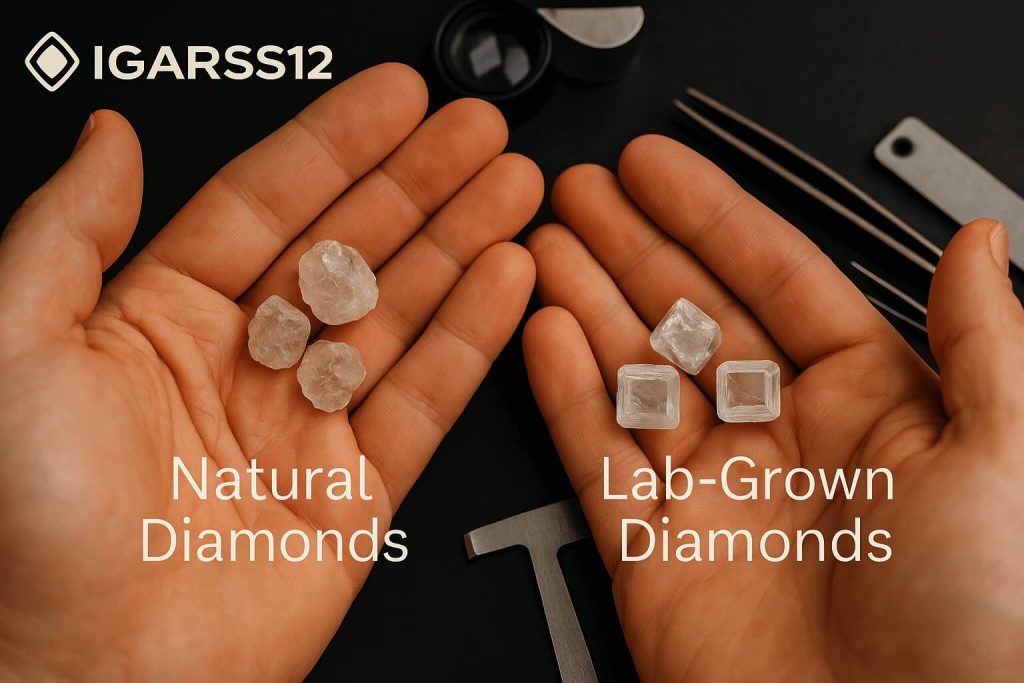
Both types have their place in the modern world, and the science behind their creation continues to evolve, blending earth’s timeless processes with human ingenuity.
The Bottomline for Us
The story of a diamond is a journey from humble carbon atoms to one of nature’s most celebrated treasures. By understanding how diamonds form, both in the earth and in the lab, we gain new respect for the science and artistry behind each sparkling gem. Whether shaped by ancient volcanic forces or advanced technology, every diamond is a product of extraordinary conditions.
Exploring the differences between natural and lab-grown diamonds helps us make informed choices as buyers, collectors or simply admirers of beauty. The natural diamond’s age and journey connect us to the deep history of our planet, while lab-grown stones highlight the power of human innovation to recreate one of earth’s greatest wonders. Both paths result in a gem that reflects light in a way few other materials can match.
Carat weight, clarity, and color are all influenced by the processes described above. The more we learn about the science behind diamonds, the more we appreciate what makes each stone unique. This knowledge gives greater meaning to the value we place on these gems, moving beyond fashion or investment to a deeper understanding of their origins.
For us, diamonds represent more than just luxury or status. They remind us of the power and mystery of nature, and the endless curiosity of the human mind. By looking beyond the surface, we discover stories written over millions of years. Stories that continue to inspire scientists, jewelers and everyone who cherishes the remarkable journey from carbon to carats.…